
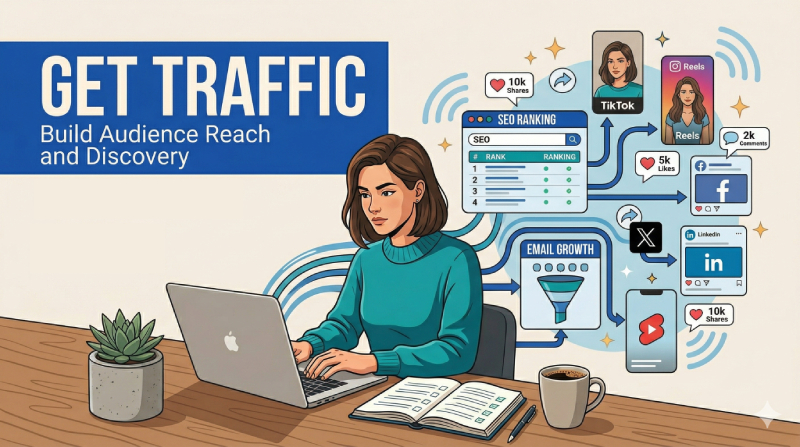
Traffic is What Makes Your Business Tick
You can build the best thing on the internet and still make zero dollars if nobody sees it.
That is the part beginners underestimate the most. They think the hard part is building the site, making the video, or creating the offer. Sometimes it feels like it is. But if you never figure out how to get attention, you are just making things for yourself.
Traffic is the bridge between effort and income.
The goal is not to chase every possible source of traffic like a maniac. The goal is to understand the main options, know what each one is good at, and choose a setup that fits your business, your time, and your personality.
Some traffic sources are fast. Some are stable. Some are great for discovery, while others are better for long-term ownership. The trick is knowing the difference instead of blindly following whatever some guru says is the “only” way.
Traffic Is Not One Thing
A lot of people talk about traffic like it is one big bucket. It is not.
Traffic can come from video platforms, social media, search engines, direct visits, or an email list. Each one works differently. Each one has different risks. And each one can be valuable depending on what you are trying to do.
A local business might do very well with search traffic because people are already looking for a service in their area. But that does not mean they should ignore social media. Social can help them stay visible, build trust, and keep their name in front of people who are not ready to buy yet.
If 100 people visit your site from social media and 10 of them convert, that traffic matters. A lot. Anyone who tells you social traffic is useless is usually selling something.
The Main Traffic Sources
There are a handful of traffic sources that matter most for most beginners.
Short-Form Video
If you have a $0 budget, short-form video is one of the best places to start.
That includes TikTok, YouTube, and Instagram/Facebook. These platforms are built for discovery, which means you do not always need a big audience to get your content in front of new people. If a video gets decent engagement, it can start reaching more viewers right away.
That does not mean every video will go viral. It does mean you have a real shot at getting initial reach without spending money. If you can consistently create simple, useful, or entertaining videos, short-form can be a strong way to build attention fast.
It also gives you flexibility. Some businesses, topics, and personalities will do better on TikTok. Others may do better on YouTube or Instagram. The point is not to worship one platform, but to stay open to the one that fits best.
Social Media
If video is not your thing, social media is the next best zero-budget option.
Facebook and X are the most obvious examples, and LinkedIn can make sense for certain business audiences. These platforms let you participate in conversations instead of just broadcasting links into the void. That is important.
A lot of people fail on social because they treat it like a dumping ground for their own content. Nobody wants that. What actually works is contributing to the community, responding to others, sharing useful thoughts, and being consistent enough that people start noticing your name.
You do not need to ruthlessly spam people with your link to get attention. In many cases, just being present and useful is enough to start building visibility.
Search Traffic
Search traffic is still one of the best traffic sources out there, but it is not magic.
Search Engine Optimization (SEO) can be powerful because people are already looking for answers. If your content shows up at the right moment, that traffic can turn into clicks, leads, and sales without you having to chase people down.
But SEO has to be done properly.
If you build weak content, ignore user intent, or depend too heavily on shortcuts, you can absolutely run into feast-and-famine cycles. Major algorithm changes can wipe out careless sites. That is why SEO should never be treated like a loophole. It is a long game, and the long game only works if you do real work.
When done correctly, SEO can still be one of the most durable traffic sources available. The key is to treat it like a serious system, not a trick.
Don’t Chase Everything
One of the biggest mistakes beginners make is trying to be everywhere at once.
They want TikTok, YouTube, Instagram, Facebook, X, LinkedIn, SEO, email, and maybe a podcast too. That sounds ambitious, but in reality it usually means they end up doing a bad job on all of it.
Every platform has its own rhythm, audience, and algorithm. If you try to keep up with all of them at the same time, you will burn out before anything has a chance to work.
That is why I recommend starting with one primary traffic source and one secondary source.
The primary source is where you put most of your energy. The secondary source is there so you are not completely dependent on one platform. And the rest? Keep them open. Watch them. Be aware of them. If one of them starts showing unexpected promise, you can shift your focus.
That flexibility matters.
You might start repurposing Facebook content to X and realize the audience there is responding better. If that happens, it may make sense to shift more of your attention to X. You do not always know in advance where the best opportunities will be. Sometimes the market tells you.
What Works When You Have No Budget
If you are starting with almost no money, this is the order I would think about:
- Short-form video if you are comfortable on camera or can create simple video content.
- Social media if you are better at writing, conversation, or community engagement.
- SEO if you are willing to be patient and build something that can compound over time.
That does not mean you can only choose one forever. It just means you need a place to start.
A lot of people want to know the “best” traffic source. That is the wrong question. The better question is: Which traffic source can I actually stay consistent with long enough to see results?
Consistency matters more than perfection.
The Real Goal
Traffic is not the end goal. Traffic is the fuel.
The real goal is to use traffic to build something more stable. That might be a website, an email list, a product, a service, or a community. If all your traffic lives on someone else’s platform, you are always one update away from a problem.
That is why I like the idea of using traffic to build toward ownership. Social platforms can help you get discovered. Search can help people find you. But your website, your list, and your own assets are what give you staying power.
You do not need to be anti-social, anti-SEO, or anti-video. You just need to understand that every traffic source has a job.
Some get attention.
Some build trust.
Some create consistency.
Some create ownership.
The smartest approach is not choosing one and pretending the others do not exist. It is building a traffic system that gives you options.
Where To Go Next
Once you know how to get traffic, the next question is simple:
How do you turn that attention into money?
That is where the next step comes in.