
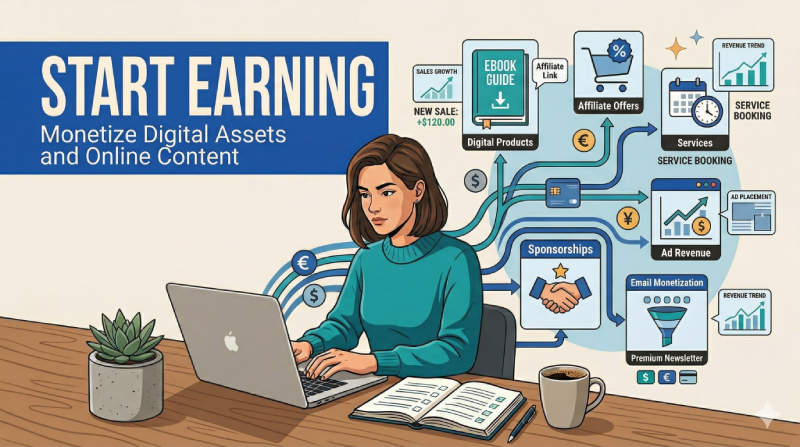
Once you have something built and people are finding it, the next question is simple: how does it make money?
That is where monetization comes in. A lot of beginners jump into this part too early and end up making a mess of things. They plaster random links everywhere, push offers that do not fit, or try to force sales before they have built enough trust.
The better approach is to understand the main ways people earn online, what each one is good at, and what kind of traffic or audience tends to fit it best.
There is no single “correct” model. There are just different options, each with their own strengths and weaknesses.
The Main Monetization Models
Digital Products
Digital products are things like ebooks, templates, toolkits, checklists, guides, mini-courses, or resource bundles.
They work well because they are easy to deliver, can be sold many times, and usually have low overhead. You create the product once, and then it can keep earning with very little additional cost.
They are often a good fit for content that solves a specific problem or answers a very focused question. If someone lands on your site looking for a solution, a digital product that gives them that solution can be a natural next step.
The challenge is that the product still has to be useful. A weak product, no matter how easy it is to sell, will not hold up for long.
Affiliate Offers
Affiliate marketing means recommending someone else’s product or service and earning a commission if someone buys through your link.
This can be a useful starting point because you do not have to create the product yourself. If you already use a tool, trust a service, or genuinely believe in a solution, affiliate marketing can be a simple way to monetize.
The tradeoff is that you are building around someone else’s business. If the offer changes, disappears, or stops converting, you are left adjusting your content around something you do not control.
Affiliate offers tend to work best when there is strong trust between you and your audience, and when the product fits naturally with the content.
Services and Freelancing
Services are one of the oldest and most direct ways to make money online.
If you have a skill people need, you can sell that skill. This includes things like writing, design, SEO, editing, web work, consulting, and more. Services can generate income faster than many other models because you are usually solving a direct problem for a client.
The downside is that services often require you to sell yourself first. If nobody knows who you are, that can be difficult. It can also be easy to burn out if you are underpricing your work or taking on too much.
Freelancing platforms can help beginners get started, but they often become competitive fast. In many cases, people end up competing on price instead of value.
Ad Revenue
Ad revenue is one of the more passive ways to monetize content.
This model is common on blogs, websites, and video platforms. Once you have enough traffic, ads can generate income without you needing to sell something directly to the audience.
The downside is that it usually takes a lot of traffic before the numbers become meaningful. Ad revenue is not always the fastest route to income, but it can become a reliable stream once the content starts getting consistent views.
This model tends to work best when you have a large amount of content or a steady audience that keeps returning.
Sponsorships
Sponsorships involve brands paying you to promote their product, service, or message.
This works best when you already have an audience and some level of trust. Brands usually want access to people who are paying attention, so the bigger and more engaged your audience is, the better this can work.
Sponsorships can be a strong income stream, but they often depend on audience size, niche fit, and credibility.
Lead Generation
Lead generation is when your content helps connect people to a service, business, or sales process.
This is common in local marketing, service businesses, and niche industries. Instead of selling directly to the audience, you are helping drive qualified leads somewhere else.
This can work very well when the traffic has high intent. For example, someone searching for a local service or a solution to a specific problem may be ready to take action.
Memberships and Communities
Memberships involve recurring payments for access to content, tools, support, or a community.
This model can work well when the audience wants ongoing guidance or connection. It usually requires trust, consistency, and a clear reason for people to keep paying month after month.
It is not always the best starting point, but it can be powerful once there is a loyal audience in place.
Matching Monetization To Traffic
Different traffic sources tend to pair better with different monetization methods.
Search Traffic
Search traffic often works well with digital products, affiliate offers, and lead generation because people are usually looking for an answer, a tool, or a solution.
That makes the transition from content to monetization feel more natural. Someone who is already searching for something is often more open to a recommendation or a product that solves the problem.
Social Traffic
Social traffic can work well with services, digital products, sponsorships, and affiliate offers.
This is because social platforms are often better for visibility, personality, and community-building. People may discover you through a post, follow you for your perspective, and then buy something later once trust has built up.
Video Traffic
Video traffic can support almost any monetization model if the content builds trust.
That is one of the reasons video is so versatile. Whether someone is watching short-form clips or longer educational content, they are often getting a better sense of who you are and what you know.
That can make digital products, affiliate offers, services, and sponsorships all viable depending on the type of audience you build.
Email Traffic
Email is one of the most flexible channels because it is owned and direct.
Once someone is on your list, you can promote digital products, affiliate offers, services, memberships, or even lead them toward other content. It gives you a way to communicate without depending completely on a platform’s algorithm.
That is one of the reasons so many creators eventually push people toward email. It is not just about selling. It is about keeping a direct line of communication open.
What Beginners Usually Get Wrong
One of the biggest mistakes is trying to monetize too early.
People want income fast, so they start forcing offers into every page, every post, and every video. The problem is that this usually weakens trust instead of building it.
Another mistake is choosing a monetization method that does not fit the audience. A model that works for one business may be a terrible fit for another. A local service business, a niche blog, a YouTube channel, and a newsletter may all need different approaches.
The better strategy is to understand the options first and then choose the one that makes the most sense for the content and the people consuming it.
How To Choose A Starting Point
You do not need to use every monetization method right away.
A good place to start is usually the model that fits your content best:
-
If you create practical content that solves a specific problem, digital products may fit well.
-
If you already trust a tool or service, affiliate offers may make sense.
-
If you have a marketable skill, services may be the fastest path.
-
If you are building for scale, ad revenue or sponsorships may become stronger later.
The point is not to force one path. The point is to understand what is available so you can make a better decision.
The Bigger Picture
Monetization is not just about making a sale. It is about building a structure that fits your audience, your traffic, and your goals.
Some models are better for speed. Some are better for ownership. Some are better for scale. Some are better for trust.
The best businesses usually do not rely on one single stream forever. They start with one, learn what works, and expand from there.
Where To Go Next
Once you understand the main ways to earn, the next step is usually understanding the person behind the site.
That is where the full story comes in.